
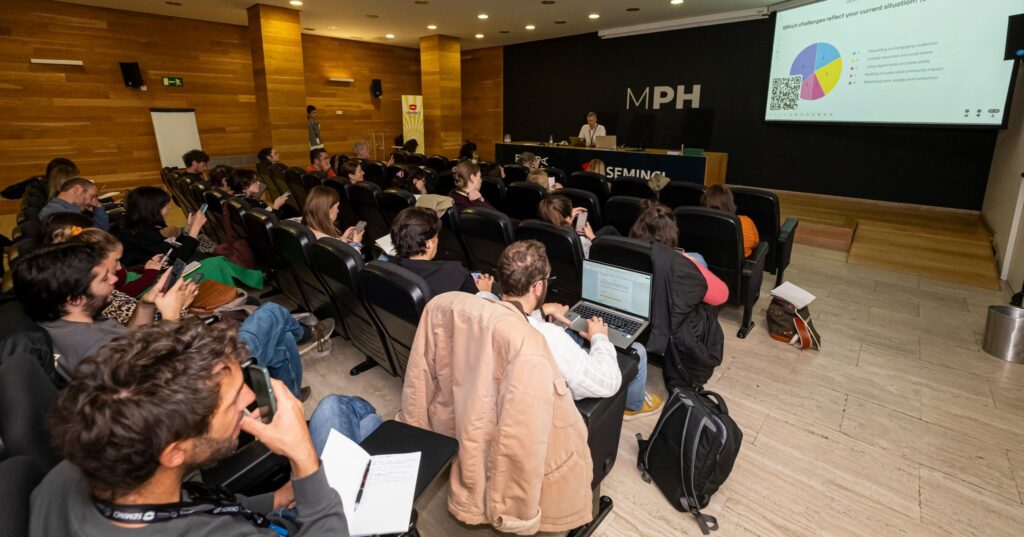
From 29th October to 1st November, Europa Cinemas held an Audience Development & Innovation Lab in Valladolid, Spain.
Working under the theme of ‘Shaping Tomorrow’s Cinemas – Innovative Tools and Skills to Navigate Change’, the event brought together participants from across Europe for four days of discussions, workshops and collaborative sessions.
Edith Pieperhoff of Galway Film Society attended the event, and has kindly put together a report which should be of interest to all access CINEMA network programmers. You can read her thoughts and take-aways from the lab below.
My participation in the Innovation Lab was a very enriching experience on an interpersonal level (making contacts with cinema owners all over Europe) and also a valuable learning experience, gaining insights into new methods to manage independent cinemas and their role in growing audiences and to build and strengthen communities.
As I was a representative for Film Societies, not an owner or manager of a cinema I was not primarily interested in presentations and workshops that dealt with building maintenance, sustainable architecture or the use of AI in managing the running of an arthouse cinema. Although I did find those presentations interesting, especially in the light of our film society looking for a new physical building to show our films.
The most valuable take-away I had from the workshops was to hear about different models to widen the audience to include:
1. younger demographics
2. people with additional needs (Visually impaired, Hard of Hearing, Intellectual Disabilities)
3. Lower income groups
- Several Models to include younger audiences
1.1 Special Screenings
Erika Borsos from Austria introduced their co-operation model to bring films with the theme of mental health in young people to cinemas in three participating countries: Austria, Hungary and Romania. A group of young people was involved in selecting the films, and in designing the program. This included not only the screening of shorts, documentaries and feature films but also workshops for the young audience to participate in: poetry slams/ visual art / song writing. These workshops were facilitated by trained Art Therapists. The young people could express feelings and thoughts about the themes touched upon in the films in a creative way.
The FILM THERAPY CLUB program was funded under the ‘Special Screenings’ scheme by Europa Cinema and shared among 4 cinemas in Vienna, Szolnok, Bucharest
However these kind of special screenings are very time and resource heavy and cannot sustain a steady stream of younger audiences to arthouse cinemas.
1.2 Retro Seasons
In an informal exchange of experiences, I learned that new arthouse films generally attract an older audience (50+ ) where retrospectives of 80’s or 90’s film directors or genre films appeal to people in their 20’s, 30’s and 40’s
Even retro screenings of Silent Era movies attract young audiences as it is experienced as an event with live music and possibly cabaret acts . I was able to confirm this trend and contribute to the discussion with my observations on Galway’s Silent Cinema Festival this year.
1.3 Subscription Models
A presentation about subscription models opened up a lively discussion about the benefits and pitfalls of these models, which are gaining popularity mostly in Holland, Belgium, Germany and Austria.
Cineville and Nonstop are the most prevalent models where people can by a 4 month minimum subscription for about €24 a month and get unlimited access to all participating arthouse cinemas.
This model is particularly attractive to students and younger people who live in larger urban areas with a choice of cinemas to go to.
As most cinema owners saw this as a welcome addition, a few saw it as cannibalising from their existing customer base and not bringing substantial new growth.
I found the concept and the discussion about it highly interesting and would like to delve a bit deeper into the possibilities of this in Ireland. - A Case Study into attracting audiences with special needs
Having participated in the workshop to plan a special screening program for hard of hearing people I immediately got our Galway Film Society to implement measures to reach out to Deaf and Hard of Hearing organisations to ask how we could make the cinema experience more comfortable for their service users. Next week we will show the Spanish film Deaf and will have a person from CHIME to translate the introduction to sign language. Hopefully this will be an ongoing inclusive measure on our part.
Inclusion of Visually impaired people would be harder to implement
Reaching out to other groups with special needs is also something to consider. Ireland has made fantastic progress in building art and theatre groups for people with intellectual disabilities (Blue Teapot, That’s Life…) so although challenging this could be a very interesting way to be open for new audiences - Lower Income Groups
Two cinema owners gave presentations about their experiences.
3.1 Michele Stefanile presented the DON BOSCO Cinema, which runs successfully since 1963 in Rome. This 500 seat, one screen cinema caters for the young with screenings for school children in the morning and mostly older people in the evening. Tickets cost €4 and €5.
They create events with talks by film directors, actors, creating events that incorporate music, theatre and education
They rely on the participation of volunteers of all ages. Their motto is: to create an inclusive community you have to be one.
3.2 Alex Lopez Fernandez from Catalonia introduced CINEBAIX, which exists for 20 years in Sant Feliu, an outskirt of Barcelona. It is affine to the Trade Union movement and positions itself on the left. The selection of films reflects this ethos. They try to be educational but not elitist in their programming choices. Emphasis is on the collective experience of watching films together
CONCLUSION
Altogether I found the Innovation Lab enormously inspiring, I felt more connected to ideas and trends that shape cinema audiences in Europe. And will definitely stay in touch with some of those cinema owners. As outlined, some of the inspirations of the lab have found a way into our running of the Galway Film Society straight away.
Images via Europa Cinemas